018: Why Runners Keep Stuff…
I’ve been unwell this weekend.
And therefore not running, which therefore means cleaning.
This unexpected interruption to our scheduled programming has given me a chance to restore some order to the physical chatter and clutter that seems to spatially embody the inside of my mind at the moment.
In a concession of defeat, I was clearing a space in the everything drawer (you know the one, you’ve got one too) to bundle a handful of important letters and charging cables into when I found an old race medal.
It was from my first Belfast Marathon. My first marathon, in fact.
For some reason, it wasn’t in the unassuming box that rests on my bookcase where all medals eventually end up.
I sat with it in my hand for a moment.
I had no idea how or why it was in there. I probably hadn’t thought about it in years. I didn’t even know it wasn’t where I thought it was. It got me thinking, though, about why I even bother keeping it. Lord knows when I’d have thought about it again if I hadn’t discovered it today.
And yet the idea of throwing it away felt strangely difficult.
Now, I wouldn’t consider myself an overly sentimental person, but perhaps this is a symptom of being a runner. We accumulate an extraordinary amount of stuff that has a material value of practically nothing, yet somehow becomes impossible to part with.
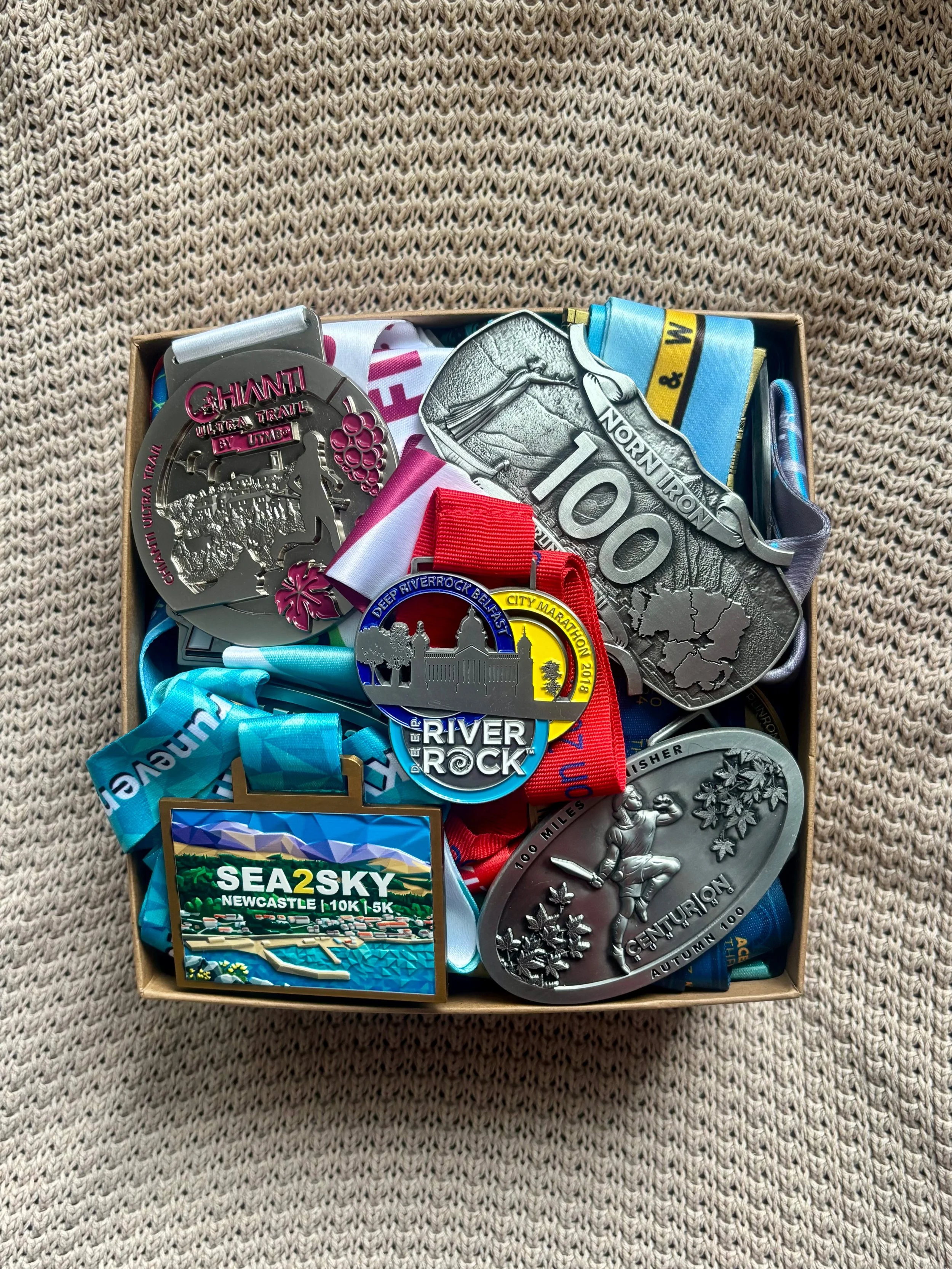
You only have to look around the room I’m writing in to find a box of medals, a wall covered in race numbers (some in considerably better shape than others) and a collection of current and retired running shoes that I can’t quite bring myself to throw away.
But I don’t think any of those things are actually what I’m holding on to, I think I’m holding on to the experiences that left their mark on them.
Objects bear witness
You met the medal when you crossed the finish line, but the shoes that carried you across that finish line also carried you all the way to the start.
They were there for the months of work beforehand. The ordinary Tuesday evenings. The long runs you didn’t particularly want to do. The mornings when the alarm went off before the sun came up. The runs that went brilliantly and the ones that made you wonder whether you were capable of doing the thing at all.
The medal only witnessed the ending. Your shoes saw almost everything.
The race number pinned to the wall is weathered and battered because you somehow managed to run through all four seasons in the space of four hours.
The shirt in the back of the drawer used to be your favourite. You wore it for almost every important race for a while. Now you’re not that fussed on it and probably haven’t worn it in months.
None of these objects are particularly remarkable, but they were there.
They bear witness to experiences that existed for a fleeting moment and then disappeared.
Running happens and then it immediately disappears.
Every footstep is temporary.
A race can occupy your thoughts for six months and then exist for only a few hours on an otherwise ordinary Saturday.
You can spend months imagining the finish line, only for the moment itself to flash brightly and begin fading almost as soon as you cross it. The elation diminishes with every second that separates you from the moment.
Of course, we have photographs now. GPS files. Strava activities. Finish times sitting permanently in online databases.
They record what happened, but recording an experience isn’t quite the same as preserving one.
They can tell you where you went, how quickly you got there and what your heart rate was while you were doing it. They can’t quite tell you what it felt like when you suddenly realised you were actually going to finish.
They can’t preserve the exhaustion of the final climb, the conversation you had with a stranger at mile 20, the relief of seeing someone you knew at exactly the moment you needed them, or the strange mixture of tiredness and contentment that existed for a few minutes after it was all over.
The experience itself is gone, and that’s why we keep evidence that it happened at all.
These objects give those moments somewhere to live.
The things we can’t put in a box
Not everything we become sentimental about can be put in a drawer or left gathering dust on a shelf.
Places can hold memories too.
There are roads, trails, hills, paths, junctions and corners that mean absolutely nothing to anyone else but are steeped in meaning for us.
The park where you ran your first 20-mile run.
The hill it took you months to run without stopping.
The lamppost you passed when you realised you were actually going to finish.
The corner where your friends and family wait to cheer you on every year.
Spend long enough running somewhere and you begin to create your own invisible map over the landscape. Someone else sees an ordinary junction. You remember the long run where everything fell apart there. Someone drives past a hill without noticing it. You remember reaching the top without walking for the first time.
There are stretches of road where you’ve watched the sun rise, trails where you’ve had conversations you still remember years later, and places associated with particular people or particular periods of your life.
We can’t lay claim to any of these places. We can’t take the hill home with us. We can’t put the street corner in a box or hang a particular stretch of trail on the wall.
But we’re sentimental about them all the same.
A runner’s sentimentality is never really about keeping material things.
It’s about remaining connected to meaningful experiences.
And, maybe more importantly, the people we were when we experienced them.
The runners we used to be
That old Belfast medal doesn’t just contain the memory of a race.
It connects me to the version of myself who ran it.
The things that frightened him then. The things he thought might be impossible. The limits he believed he had and the questions he was trying to answer about himself.
Running gives us a peculiar way of measuring how much we have changed. Something that once represented the absolute limit of your endurance might eventually become the minimum distance you’d consider for a Saturday long run.
The hill you once celebrated running without stopping becomes part of an easy loop.
The distance that kept you awake the night before a race becomes something you barely think twice about.
Experience makes us more capable, but it also has a habit of making things ordinary that once felt extraordinary.
And there can be a temptation to look backwards and diminish those achievements because of the runner we subsequently became.
It was only a 10k.
I didn’t run ultras then.
I could run that much faster now.
But we shouldn’t judge our old achievements using the runner we subsequently became.
That first 10k medal still belongs to the version of you who showed up to their first race and felt like they had conquered the world that day.
Your first marathon doesn’t become less significant because you eventually ran an ultramarathon.
If anything, perhaps it becomes more significant, because now you can see what it started.
The things we keep become something like an archaeological record of ourselves.
Different shoes belong to different periods of our lives. Race numbers correspond to ambitions we once had. Medals mark distances that were once unknown territory. Individually, they might not look like much. Taken together, they form a sort of accidental autobiography. And because the change happens gradually, we rarely notice ourselves becoming someone different while it is happening.
It’s hard not to see the irony there.
For a sport so preoccupied with forward movement, runners can be remarkably sentimental about what lies behind us.
Why we keep stuff
So maybe we’re not actually precious about medals, shoes or battered race numbers.
Maybe we’re sentimental about time.
About places.
About struggle.
About the things that once frightened us and eventually became familiar.
About the versions of ourselves that existed briefly before making way as we continued becoming something else.
The objects we hold on to simply give those moments a tangible existence in the physical world.
Which brings me back to the Belfast medal sitting by my notes for this conversation.
It was funny thinking about that version of me.
How poorly he had prepared for the weather that day.
How he somehow managed to stomach that many gels.
How enormous 26.2 miles seemed.
And how he had absolutely no idea where running was going to take him next.
I don’t need the medal to remember that he ran the race.
The result exists somewhere online. There are photographs. I’m sure there’s a Strava activity buried deep enough in my account if I really wanted to find it.
But none of those things were what I was thinking about as I held it.
I was thinking about him.
Someone who was me, but isn’t the person sitting here writing this now.
Maybe that’s all a runner’s sentimentality really is.
Not an attachment to medals, old shoes or battered race numbers, but a reluctance to let meaningful moments disappear completely.
So we give them somewhere to live.
In boxes and drawers.
On walls and shelves.
On particular corners of otherwise ordinary roads.
That Belfast medal is now back in the box with all the others.
Years-ago me put a lot of work into putting that first entry in there.
And I think it does me good to remember him once in a while.